
On most small installations someone eventually asks why the cables cannot go straight from the ceiling into the switch. It would work. It is cheaper. And it is the decision people regret first.
What the panel is actually for
A patch panel is the point where the permanent cabling ends and the changeable part begins. Solid in-wall cable is punched down onto the back of the panel once and never touched again; the front is RJ45 ports, patched to the switch with cords you can move freely.
That boundary is the whole value. Without it, every change to the network means handling cable that was meant to be installed once.
What you lose by going direct
- You crimp plugs onto solid cable. RJ45 contacts are designed to pierce between the strands of stranded cable; against a solid conductor the contact is smaller and degrades over time. It passes on the day and fails intermittently later
- You cannot swap the switch cleanly. Replacing a switch means unplugging forty crimped ends and hoping each one survives the handling
- You cannot test to a standard. Certification testers measure a permanent link between defined terminations. A crimped run has no defined end
- You cannot trace anything. A panel is numbered and labelled; forty identical cables entering a switch are not
- Every move means re-crimping. Which shortens the cable each time, and the cable was cut to length
What the panel costs
A panel, the jacks or punch-down connections, an extra patch cord per run, and a rack unit or two. On a 24-run job that is a real but modest line — and it is roughly the cost of one afternoon of an engineer tracing an untraceable rack.
Label at both ends, at install time
The panel only pays if the ports are labelled and the outlets carry the matching number. It takes minutes during installation and is nearly impossible to reconstruct afterwards.
Keep it simple and durable: floor, room, outlet — 2-CONF-04 on both the panel port and the wall plate. Write the scheme on a label inside the rack door.
Give it a manager
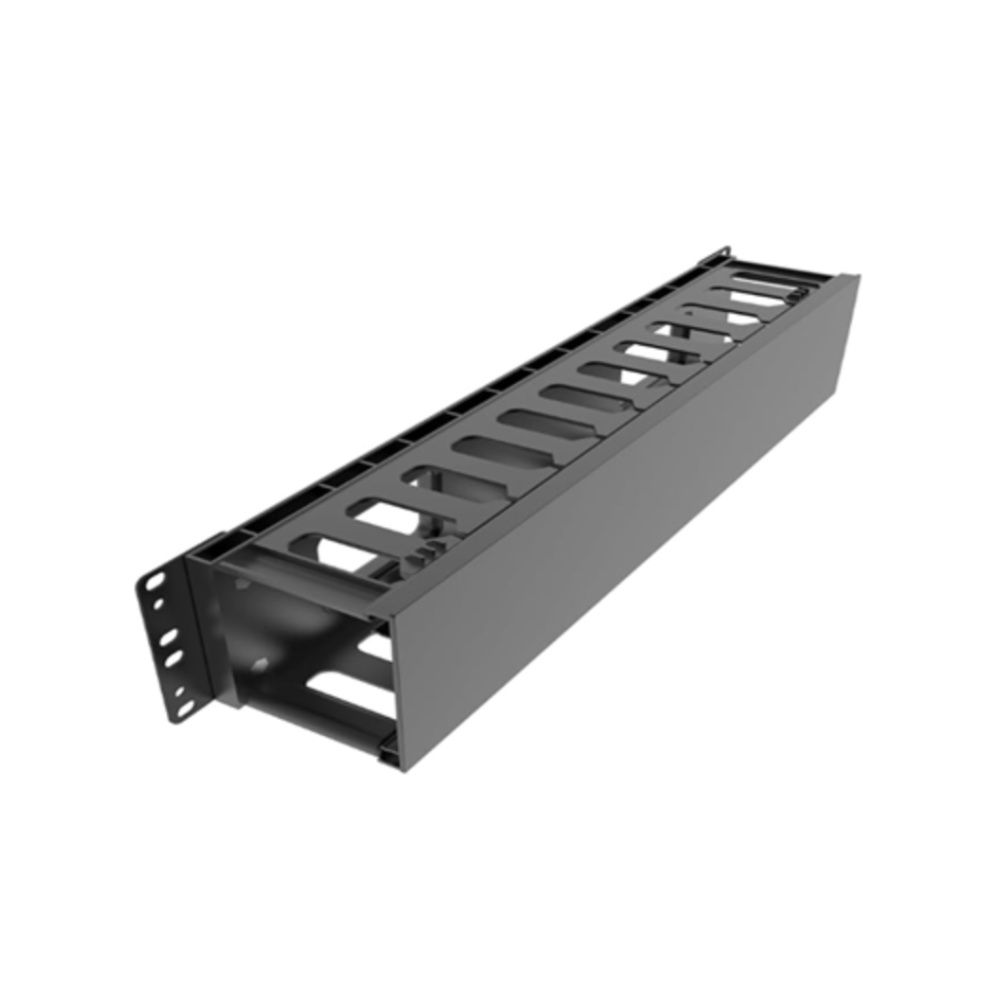
A horizontal cable manager between the panel and the switch is what makes the patching survive contact with reality. Without one, cords cross, sag and become impossible to follow; with one, a link can be traced by eye a year later.
Ours is a 2U 12-slot horizontal organiser, and it belongs directly between panel and switch rather than at the bottom of the rack.
The defensible exception
Four runs into a small office switch in a rented unit you will leave in a year: go direct if you must, use stranded cable, and accept that the install is temporary. That is a considered trade, not a saving.
Anything in a wall, anything that will outlast the current tenant, anything with cameras on it — put in the panel.
What to order
- Patch panel ports to match the run count, rounded up with growth — see RJ45 connectors and patch panels
- Keystone jacks for the outlet end — D-Link or CommScope
- A horizontal manager between panel and switch — 2U organiser
- A rack sized for panels, switch and any recorder — Netfox 9U wall mount, or see racks and cable managers
The full passive list is on our structured cabling products page.