
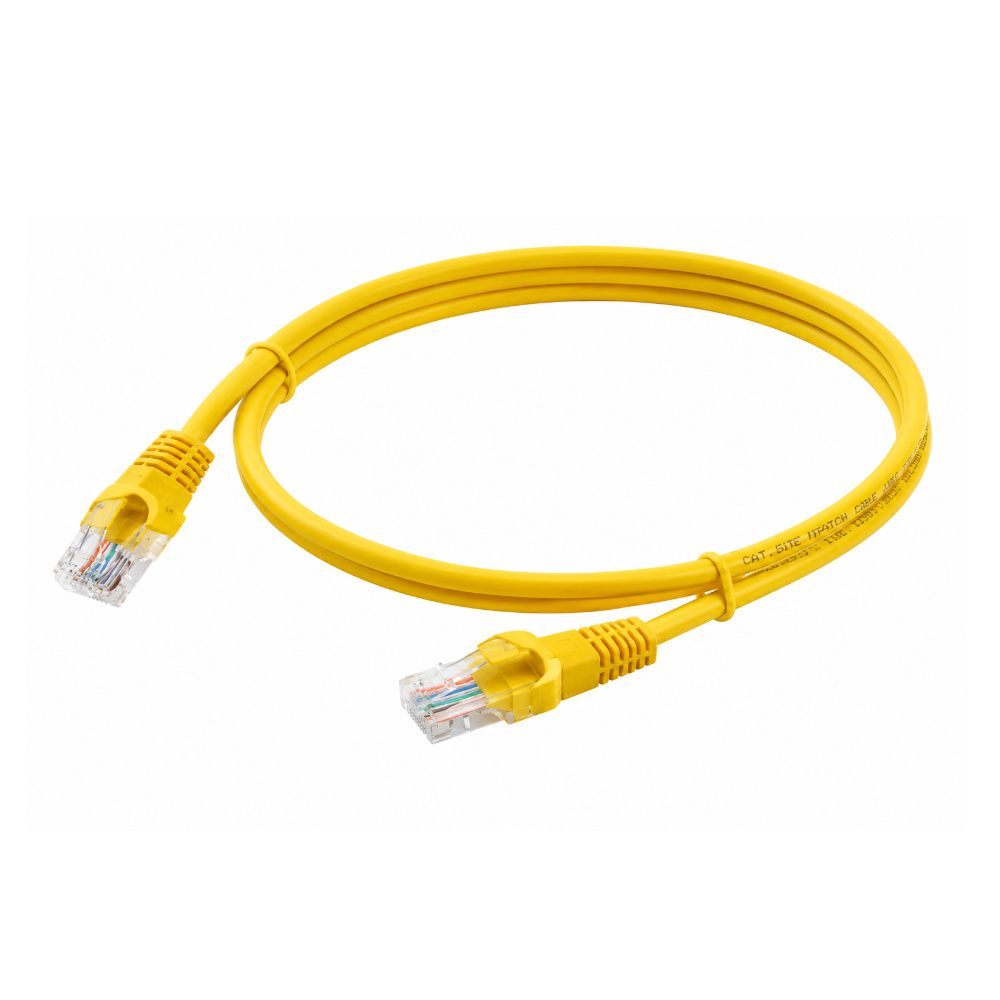
Cat6 comes in two conductor constructions, and they are not interchangeable. Solid is a single conductor per pair; stranded is many fine strands twisted together. Both are Cat6, both are correct, and each belongs in one place.
The rule in one line
Solid for the permanent link. Stranded for the patch cords.
The permanent link is the cable that goes in the wall or the tray and does not move again — from the patch panel in the rack to the outlet on the wall. Patch cords are the short flexible leads at each end: rack to switch, and outlet to device.
Why solid for the permanent link
- Lower attenuation. A single conductor carries the signal with less loss than the same gauge in strands, which is what makes the full 90-metre run work
- It punches down properly. Insulation-displacement contacts in jacks and patch panels are designed to bite into a solid conductor and hold it
- It does not need to flex. Once installed it never moves, so the one weakness of solid conductors is irrelevant
Why stranded for patch cords
- It survives movement. A cord behind a desk gets pulled, bent and trodden on; solid conductor work-hardens and eventually cracks
- Tighter bend radius. Stranded takes the turns behind a rack without kinking
- RJ45 plugs are built for it. Plug contacts are designed to pierce between strands
Standard Cat6 patch cords use 24 AWG stranded bare copper — that is what a factory cord is.
The mistake that fails late
The common shortcut is crimping an RJ45 plug straight onto solid in-wall cable to save the cost of a jack and a cord. It works. It passes a continuity test on the day. And then it fails — because the plug contact was designed to pierce between strands, and against a solid conductor it makes a smaller, less stable contact patch that degrades as the building moves and the cable is nudged.
When it fails, it fails intermittently, which is the worst kind. The link works, then does not, then works again while you are looking at it. Tracing that costs more than the jack would have.
There is a second cost: a crimped run cannot be tested, traced or re-terminated cleanly. A jack and a patch panel give you a link you can certify and a device you can swap without touching the cable in the wall.
Buy cords, do not make them
Factory patch cords are moulded, tested and boot-protected. Hand-made cords using stranded cable and a crimp tool are legitimate and occasionally necessary, but they are not cheaper once you count the failures and the time.
Buy the lengths you actually need. A coil of surplus cord behind a rack is a common reason a link that passed on installation day fails certification later, and it makes tracing harder for whoever comes next.
What to order
- Solid Cat6 by the box for permanent links — Molex Cat6 UTP cable
- Keystone jacks at the outlet — D-Link or CommScope information outlets
- Face plates for the outlet position — Honeywell Cat6/Cat6a face plate
- Factory stranded cords at both ends — 1 m and 2 m
- RJ45 plugs only where you genuinely need to terminate stranded cable — D-Link RJ45 connector modules
The full passive range is on our structured cabling products page.