
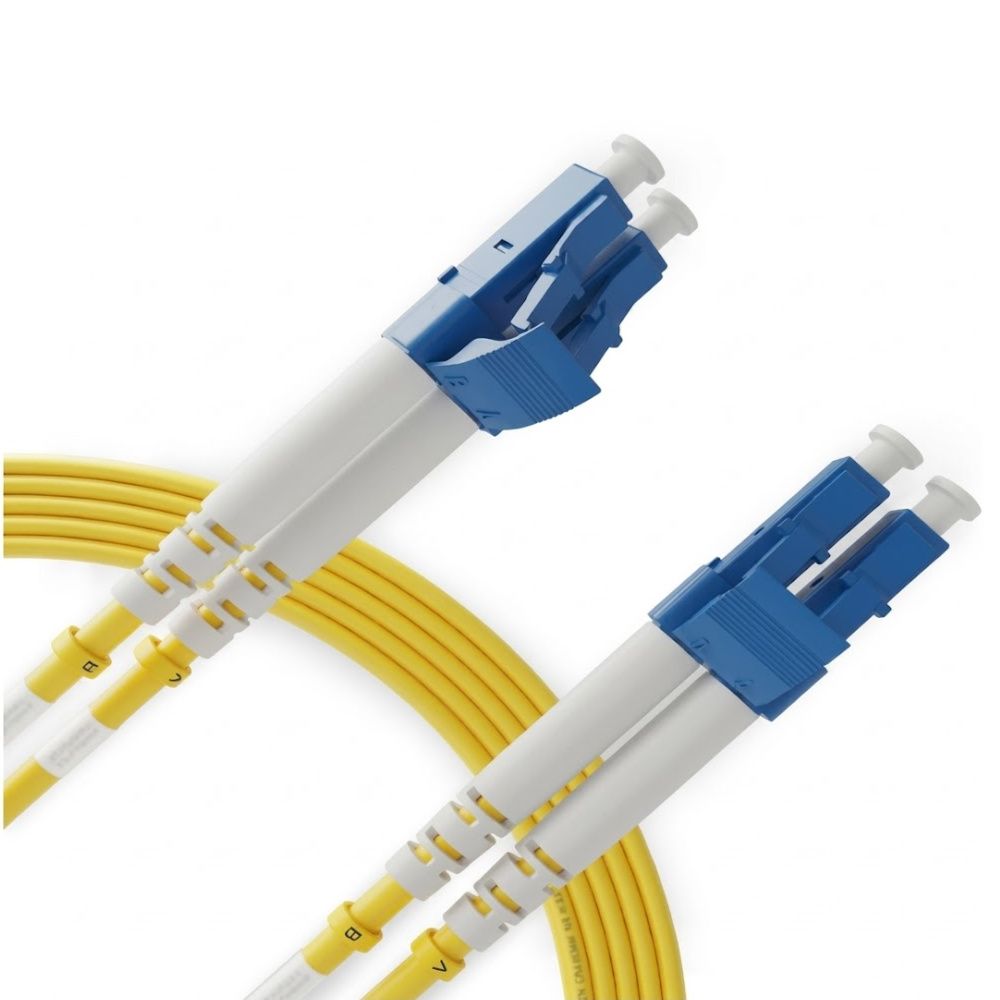
Fiber comes in two families and they are not interchangeable. A single-mode patch cord will physically plug into a multimode link and the light will go nowhere useful. This is the first decision on any fiber job, and it is made by distance and by the transceivers, not by the cable price.
The short answer
Multimode for links inside one building — floor to floor, block to block on a campus, rack to rack. Cheap transceivers, easy termination, and comfortable to a few hundred metres.
Single-mode for anything leaving the building, anything over a few hundred metres, and anything you expect to carry more bandwidth later.
What actually differs
Core size
Multimode has a wide core — 50 or 62.5 microns — so light bounces down it along many paths, or modes. Those paths are different lengths, so a pulse spreads as it travels. That spreading is what limits distance.
Single-mode has a core around 9 microns. Light travels one path, the pulse holds its shape, and the link reaches far further.
Distance
- OM3 multimode — 10 Gbps to about 300 m
- OM4 multimode — 10 Gbps to about 400 m
- Single-mode — 10 Gbps to 10 km and beyond, depending on the transceiver
For most Chennai office and campus work, that first number decides it. If the run is under 300 m and stays inside the property, multimode is the practical answer.
Transceiver cost
This is the part that reverses the intuition. Single-mode cable is not meaningfully dearer than multimode. Single-mode transceivers are, because the optics are more precise. On a short link with many terminations, multimode usually works out cheaper overall; on a long one, single-mode is the only option at any price.
The mismatch that leaves a link dark
The commonest fiber fault we are called to is not a broken cable. It is a mode mismatch somewhere in the chain: single-mode pigtails spliced to multimode cable, or a multimode patch cord bridging a single-mode LIU to a single-mode transceiver.
Everything connects. Nothing works, or the link comes up and drops under load. Confirm the mode at every stage — cable, pigtail, adapter, patch cord, transceiver — before ordering, not after.
Colour helps but does not decide it: single-mode jackets are conventionally yellow, OM3 aqua, OM4 violet. Conventions get broken, so read the print on the jacket.
Choosing, in order
- Measure the actual route length, not the straight line
- Decide whether the run leaves the building — if yes, single-mode
- Check what the switches at both ends accept, and what SFP modules exist for them
- Add the bandwidth you expect in five years, not today
- Fix the connector type — LC or SC — and keep it the same end to end
We supply LC-LC and SC-SC patch cords, and source OFC, LIU enclosures, pigtails and adapters against the project. Send the run length and the switch models and we will confirm mode, connector and transceiver together — see the fiber and OFC page.